"Ex Africa semper aliquid novi", quoth Pliny the Elder. There is some debate about what he really meant, but most likely he meant trouble. In this sense has the phrase been used most often since but I hope to reverse the trend and on these pages bring you the exciting, novel and curious out of Africa.

And wherever I am I hope to remain,
Ex Africa Semper Yours,
Berenika


Sunday, 20 September 2015

On the long finals: Kiserian - Kampi

Leaving the friendly homestead was certainly not easy. It was hot, I felt weary and my feet were blistered raw - it turned out my trustworthy hiking boots of ten years had holes in the soles; sand and water were by now pouring in unrestrained. Interestingly, the pretty red nail polish on my toenail held. But there were still over 30 kilometres to Kampi ya Samaki and I knew that I had to cover a bit of that if I were to have any chance of finishing the trip the next day. Furthermore, welcoming as Joseph and his wife had been I had the feeling I was imposing ever so slightly on their long-awaited moments of conjugal reunion. I left them with most of my remaining food supplies and accompanied by Joseph's younger brother, Eugene, set off across the delta.

Pretty
One of the main rivers which feed lake Baringo, Perkeera, discharges its waters on the southern shore, forming a formidable delta, flat and marshy. When the lake was high, this place must have been impenetrable, a crocodile infested bog. The road would have led much more southerly, all the way south of a small lake, curiously named Lake 92, which once upon a time was but a part of the main aquifer. Now the waters have retreated and there is a way between the two lakes - for those who know it.

For the first few kilometres west of Kiserian the land is criss-crossed with living fences, surrounding little shambas. They are generously irrigated through a maze of little open canals, through which water flows merrily. The place is green, with groves of thin-twigged acacias casting latticework shadows. It was late afternoon and everyone was out, strolling or lolling about near shamba gates. There even were flowers. The whole place seemed a little like a small town suburb, comfortable, relaxed and peaceful. Eugene, with a sweaty, heavily encumbered mzungu in tow was certainly in the centre of attention and we were stopped quite often to exchange greetings.

It would be impossible for me to retrace my steps on the road that Eugene took. He zigged and zagged, picking ever smaller pathways between fences; sometimes he would walk right across a field ignoring the fences altogether. We'd hop over the canals, duck under branches and still he'd lead on unwaveringly. According to my useless google maps print out it was possible to go due west from Kiserian but Eugene pushed steadily south-south-west. After an hour of this I had to stop and slump, while Eugene looked on with a mixture of concern and disdain in his eyes. Three men overtook us and stopped, waiting for me to get up.

Due West
They were from the Youth League and the very same men that I met in the morning, constructing the secondary school, some 15 kilometres away. Did they commute to work on that stretch every day, twice? I hoped not, for this would make my effort look even more feeble that it actually was. In any case that day they were going home to the same village that was to be my destination, Ngambo.

We now turned due west. There was no mistaking about it because a massive, bright red sun was right there in front of me, blinding me completely. It was so bright that I could look nowhere but down at my feet. Which actually was not that much of an inconvenience - I had been looking down at my feet for most of my trip anyway. But this area was stunning and well worth an occasional tortured peek.

A bridge. Sort of.
The land was flat and limitless. Green but devoid of trees. Just ankle-high shrubs as far as the eye can see. It was curiously uneven, with cracks and mounds spread willy-nilly. I realised it was the old lake bottom that we were walking on, the earth dried up and convulsed by the sudden disappearance of waters. It was bloody uncomfortable to walk on. I kept stumbling and cursing under my breath.

We would cross rivers, obviously the spidery distributaries of the main river, most of them jumpable but some requiring bridges. Sort of.

The beauty of the place, and the sense of the surreal, was enhanced by the smokes rising lazily from the ground. Charcoal burners. The place was littered with little heaps of piled up earth. What were they making their charcoal from was hard to tell as there hardly was a tree left, if there ever had been any.

Right in the middle of all that we stumbled upon a hole. It was no ordinary hole. It was a well. One of those shallow wells, dug out by hand in the seemingly waterless spot. I have read about them in desert adventure books. Finding things in real life that I had read about as a kid in books always makes me happy and this well was no exception. Besides, it contained water. A woman was standing waist deep in the cool cavern, her plastic sandals cast aside. She was scooping the water from the little puddle that formed at the bottom of the hole and filling the cups and barrels of the people around. We had our cups filled too and we drank greedily. There was something biblical about this encounter, a woman quenching the traveller's thirst from her well, the infinite hospitality of the bush. 

Rebecca of Kenya
I wish I have had more time to ask how the well worked, who dug it, who manned it, if they normally charged for it but we had to push on, as now the sun was really low. By now I was seriously tired and there was no end to the flats in sight. But they did finally end, with tangly bush groves surrounding a river, wide enough for us to have to take our shoes off and wade across. We followed it upstream, along an usually neat and tall anti-flood dyke, to the village, passing a primary school to our right. My destination was the secondary school, where I was hoping to find refuge for the night.

Most rivers were jumpable.
I am a little embarrassed about the next part. There was some dilly-dallying at the gate but the askari finally let me in and led me to a place he thought suitable and left me to set up my tent. It was already dark, and my spot was quite secluded, under a tall tree behind some school buildings, so I was hoping that no one will know of my presence until the morrow. It was not meant to be, of course. The students, returning to their dormitories from their evening meal, saw me and rushed to examine the curiosity. They encircled my spot and were coming ever closer giggling and whispering. I'm not sure if I even said hi. I might have nodded or waved but it was too dark for them to see anyway. I kept busying myself with the tent, hoping they would go away. I was so tired, that any idea of human interaction, small talk or any more of questions was abhorrent to me. I just wished them gone so that I could crawl into my tent and pass out. When they approached close enough to step on one of my tent pegs I finally burst out and barked at them to keep away. Immediately I felt silly. 

Some teachers emerged from the crowed and shooed the youth away. They introduced themselves, Jackson, the head teacher, and Alice, the matron. I apologised for my outburst. They asked if I needed anything. I said I didn't. They came back with a blanket, washing bowl and soap and a cup of hot and milky tea. They warned me about snakes and bid me a good night. I really felt quite bad.

I was about to go to sleep when the askari came saying the headmaster had arrived from the village and wanted to see me. He was a funny chap, a little pompous in his officiousness, friendly but obviously not quite sure what to make of my presence. To make up for my hostility towards the students and to placate his uneasiness I promised to address the students at the assembly the next morning.

That I did and it was a little surreal. They were all so eager and attentive. I spoke of who I am and of my trip, why I did it and why they should too. None of them had ever been to Ruko, only 20 kilometers away from Kiserian, where most of them lived. I tried to explain why I didn't take a car, and why I walked alone. It wasn't easy because I didn't rightly know myself. I just wanted to I guess. Because I could.  

They were sympathetic, I got a few laughs. The headmaster spoke after and thanked me for coming, for 'representing' (whatever that meant) and for staying focused. He said I was an inspiration and that the students will be having their 4th form exams this term and they should stay, what? "Focused!", replied the classroom in unison. Quite the demagogue. 

I left them at their desks and set off for the last stretch, which is a little more than a blur in my memory. I walked alone most of the time, asking the way at every junction and answering the inevitable questions. 

Where to? Where from? Really? Alone? Walking? You don't fear? Imagine!

By now I had got quite good at adopting a cheerful, nonchalant tone, polite enough but not too engaging so that I could still walk as I answered. The area was very densely populated now, so close to the main road. I got lost in a maze of lanes and fences a couple of times but there was always someone to lead me out onto a bigger path. An old men with a panga who walked really fast through a beautiful grove of thin tress. Maridadi sana, I remarked. Very Beautiful. Ah, ni bure, hakuna maana. Mkaa tu. Ah it's useless, no meaning. Only good for charcoal, he replied. A woman with swaying hips, 20 litre mtungi on her head but empty. "The water is far, we have to walk many miles to get it", she complained. But she still led me way out of her way and wanted nothing for it.

There were now fences and gates everywhere and the path led in straight angles. I walked to compass turning, left or right as I saw fit. I knew I was getting close but wasn't quite prepared for the sudden appearance of the tarmac road when I rounded a random fence. It was an abrupt end. Some kids run up to me and asked me for money. I knew I reached civilisation at last. 

Civilisation


Friday, 11 September 2015

Through the bandit country: Ruko - Kiserian

Day 3 Friday, 28th August

Route: Ruko - Kiserian - Ngambo
Start: 7.45am
Finish: 6pm
Distance: 32 km

The welcome I got at Ruko was fantastic, a much needed haven after a day like mine. Joseph, the head ranger, was the one to greet me at the gate. There were six others in the compound, a pleasant place with a few green rondavels and neat paths laid out with white-painted stones. Clumps of aloe were in bloom - the little orange tubular bells so loved by sunbirds - and a few rickety acacias cast a pleasant shade. I let my rucksack slide of my shoulders and land with a heavy thud, immediately followed by a heavy sigh of relief.

I had only one question. Can I swim in here?

The place was so tantalisingly close to the lake that it seemed improbable that there would be no path leading towards it. But the reply was crushing. No, not really, it's very shallow and there are crocodiles. My heart sunk.

Unless, continued Joseph, we take a boat.

And in no time, this angel of mercy had oars in one hand and a can of petrol in the other. I changed into a swim suit and was out in minutes but in my burning desire to get into the lake I forgot my camera. I would regret this for lake in the setting sun was stunning.

Different trip, same lake
But first we had to get to it. We walked on a muddy path, through a land that was desolate and uneven, broken branches and tangled reeds everywhere, the result of lake retreating some 100 meters in the last couple of years. The original jetty was close to the camp, now the boat laid among the tree stumps in ankle deep dark mud. Black pipes run into the lake, sucking out water for the camp. A splash and a ripple betrayed the presence of a crocodile, dismayed by our intrusion. They were right, not quite Bondai Beach that.

We pushed the boat out and paddled through the mire. It was eerie but infinitely beautiful. The tree stumps in front were back against the setting sun, phantasmagorically twisted. Those behind were basking in the golden light, contrasting sharply with the dark blue skies and waters. Birds were everywhere: perched on the branches,  fleeting between them, bobbing on water or diving into it. Cormorants, pelicans, darters, egrets, king fishers, weavers, water hens, herons and others which I could not name.

A rock in the lake
The engine, finally free of the flotsam, revved and we were off into the open lake. Far enough from any crocodiles now, I jumped out and swam. No words can describe the joy of it. I have also never before (and hopefully after) swam while drinking at the same time. I didn't care, it was water and it was sweet and lots of it. I must have drunk a gallon.

We returned by nightfall and I made my camp. We sat and talked with rangers for a while, wrapped in a shuka they kindly gave me, drunk tea and ate some soup with rice I had leftover from lunch. I was tired but now clean and relaxed. I slept like a stone.

Some really annoying birds woke me up the next morning, with their blasted joyful song. The rangers were already up. They were very excited - today was their shopping day. They would take the boat and drive for forty minutes to Kampi ya Samaki to get their provisions for the month, also see some friends, maybe drink a beer. They were trying to decide who gets to go on this fun trip and who gets to accompany the silly mzungu on her silly trip.

The previous night it was decided that someone has to. The area I was about to cross was no-man's-land, a cattle raiding country inhabited, occasionally, by moran and their herds only. They - according to my guides - were a lawless and bored bunch, far away from their mothers and they could hurt me if I stumbled into them.

Cattle raiding in the north of Kenya is an unresolved issue. Cattle keeping communities, like the Pokot, Turkana, Rendille, Desanach, Samburu and Borana regularly organise raids to steal each other's cattle or revenge the cattle that had been stolen. It's been going on for ever, but now guns are involved. People die but the police is powerless. The communities deplore that but with the same breath declare boastfully that it's because the police is scared of their warriors and cannot match their skill in the bush. As a result, whole swathes of land between communities, like the one I was about to cross, are abandoned and dangerous.

The communities in question here are the Pokot and Njemps. The do not see eye to eye. Pokot are purely cattle keepers and the Njemps have uniquely among all pastoralists adapted to a semi-sedentary lifestyle around the lake. They grow crops and fish. They used to do it in the area but some 15 years ago they were chased out. Joseph, my guide, was one of those displaced. The raiders came in the morning, shooting everywhere. All his father's goats, hundreds of them, were taken. Only the little ones were left but they died without their mother's milk. His father was left destitute and there was no more money to send his brothers to school. They moved to Kiserian, on the southern shore, the place where we were now headed.

In one of those comical twists of fate that gods love so much, this area was called Nosuguro. Seeing it on google maps I was concerned thinking that some helpful Spanish person, maybe a 19th century missionary, has branded it so, knowing it is unsafe (no seguro). The origin of the name, however, is Njemps and much more banal. It means 'an aloe'.

And there were plenty of them along the way, and I was cutting them to sooth the burning on my shoulders. We walked at an insane pace, the three rangers travelling light, with only camelbaks as luggage. At first we, or should I say they, picked a path through the dried up moorland, trying to hug the lakeshore as much as possible on our way south. It was a flat country - with the beautiful rift valley escarpment towering to east - but overgrown and therefore hard to navigate accurately. Even the rangers were hesitant, every now and again running into a swamp and turning further east - I would have stood no chance of making it though it on my own in any decent time.

We saw impalas and warthogs, with their little ones following the mother's antenna-like tail through the long grass. They rangers were on patrol so they keenly counted all that we saw and monitored the tracks. They pointed ones I had never seen before - a crocodile dragging his heavy belly through the mud, a long furrow not unlike a tread of a tyre but with funny little feet on the side.

There were other tracks too that they pointed out, ones that got them worried. Men. About 20 of them. Coming south in the night. Cattle raiders.

A road and some rocks. Gives you an idea.
We reached a dirt road and - I didn't think it was possible but - they sped up. I didn't want to complain but the look on my face must have said it all. "Tired?" They inquired politely. "We could walk like this without stopping all day and all night, all the way to Kampi", they boasted. I wanted to hit them but I didn't.

As a result I do not remember much from the bit that must have been the most beautiful to walk through. The road was flat and open, with bush of medium thickness on both sides, and formidable red cliffs - walls of the rift valley - not too far away on my left. Little streams, dry obviously, crossed our path. one of them was called 'the Lion' - if you follow it upstream you will reach a cliff and in it a cave so big, 20 men can comfortably live there. That's where cattle raiders like to hang.

We started meeting Joseph's fellow Njemps and they would join us for a walk and a chat and then peel off back into the bush. He was warning them of the cattle raiding party and they in turn would warn the others. We rounded a bend and walked into a group of four men, barefoot and wrapped in kikoys - all armed with AK47s. The welcome party for the raiders. The word in the bush really does travel fast. They have already heard and they were ready, searching for the Pokot and devising the best place to lay and ambush. What will they do if they find them, I asked. They will 'chase' them, was Joseph's circumspect answer.

After three hours of this we reached a building site - Kiserian secondary school built on the lakeshore by the Youth League - where two of our rangers left. We were now safely in Njemps land so there was no need for a Pokot ranger. We still had an hour to go till Kiserian proper and it was almost midday so we did not waste much time and set off.

We were now on a heavily used path running among tall green reeds and grasses. Women and children busied themselves fetching water from the lake, cutting grass or burning little charcoal fires. The area was treeless. But the cows were abundant and Joseph would make sure I knew which varieties they all belonged to. I can't remember a word of it.

A shadow of her former self.
A hill loomed in the distance, right by the lake, looking like a Saxon fort, with a clump of trees at the top and neat looking buildings among them. A missionary dispensary run by the African Inland Church. One of the nuns who run it just died and people of Kisarian are trying to find money to got to her funeral in South Africa. She was well-loved, apparently.

We reached Kiserian - which translates as the place of peace - just as I thought I was not going to make a step further. It kind of sprung on me, from behind a little grove of acacias. And suddenly we were in an oasis of wide-canopied thorn-trees and neat little plots, all separated by straight rows of impenetrable 'living fence', cacti with mean-looking thorns. It was shaded and quiet and I liked it on the spot.

I liked it even more when we reached the inevitable tin-shack shop and I was given my customary Sprite. We rested a little as Joseph pointed out the local attractions: a chief's hut, the secondary school (boys only), the GSU compound. There was even an airstrip, a little neglected perhaps, but looking usable all the same.

Joseph was getting restless, he was so close to his mother's homestead and it was almost time for lunch. Reluctantly I got up and we went through the village, saying 'serian' (peace) to all and sundry as was the custom. There is a bridge over the Embossos river at the end of the village and when you cross it you're no longer in Kiserian but in a place which has the same name as a twig with which you can clean your teeth.

Joseph's boma.
The parents were out tending cattle so it was Joseph young and shy bride that greeted us. She still lived with his parents. Only when the first child is about to be born will Joseph negotiate with his father and uncles for the livestock he will need to start his own homestead. He will need to brew a lot of honey beer for them first though. That sounded delicious and I have a weak spot for home brews so I made him promise he'll invite me when that happens.

Lunch was served and it consisted of rice and potatoes mixed together. I still had a packet of my Polish gravy so I offered it as my contribution. They were polite about it but I don't think it will catch on.

After lunch it was time for a nap. The goats have taken all the best spots of deep shade so I was left with a movable patch under a tree. I tried to read a bit but dozed off immediately, desperately tired as I was after the latest 20 kilometre stretch. There was still over 10km ahead of me if I wanted to make sure I can reach Kampi ya Samaki the next day. Should I attempt it or stay in Kiserian taking it easy?


Monday, 7 September 2015

Goatville - Ruko

Day 2, Thursday 27th August (continued)

Goats. Again. That sneezing and farting, and stomping. Lots of stomping. Before I managed, blurry-eyed and disoriented, to get my bearings, there were already goats everywhere: next to my head, nibbling on my bag, sniffing my toes. Even treading on the still hot ashes (seems like they don't have many nerve endings in the hooves but maybe that's all animals). In any case, there were hundreds of them and it was highly confusing.

Goat invasion
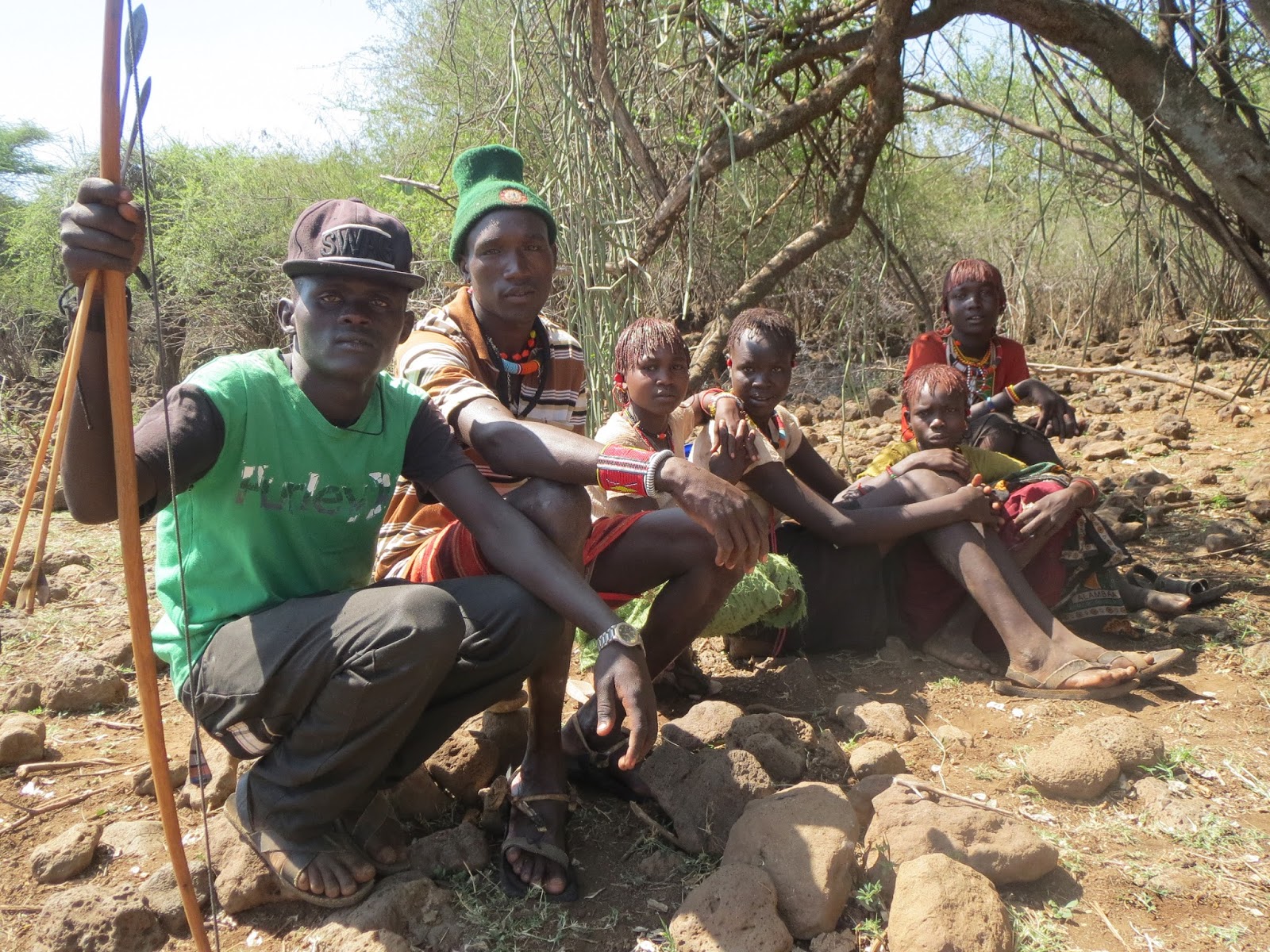
Behind the goats followed a Pokot family. Little boys with twigs for goat whipping, girls with jerry cans and finally two grown up boys, one carrying a bow and arrows, the other with a mobile phone blasting music.

They greeted me wearily and squatted some distance away, casting shy glances. The goats kept swarming around me. It was a highly awkward social situation.

One of the older boys was the first one to break the ice. He was also the only one who spoke anything but Pokot. They were from the village at the top of the hill, he said. They came to water the goats and give them dawa. They had 500 goats. So could he borrow my panga?

Japuan (back) and her sisters
As the boys busied themselves with herding the goats into an improvised kraal, the girls set about me. They didn't speak a word of Swahili, not even as much as to tell me their names, or maybe they were just shy. In any case, they were happy just to sit by and watch me. The eldest was sporting a fine bead necklace, to which she affixed a small plastic mirror/hair brush. She kept gazing into it, admiringly. Rightly so for she was very pretty. Her hair was died with red ochre and she had ornamental earrings. Her clothes, however, were modern and tattered.

Her name is Japuan, said her brother. That means one that was late. She is 16 and she is already circumcised. She is almost ready to be married. Was he married, I asked? Not yet because he is the one who went to school. He was in form four and wanted to be a doctor. But his older brother was married and already had goats of his own. That was the boy with bow and arrows. How many other siblings does he have then? Oh, about 24. My father has four wives. That explained all the goats...

The girls fetched water from the lake for me and the boys helped me boil it. They asked why and I felt silly saying that I think it's not so good to drink otherwise. They were understanding though. Ken, for that was the name of the oldest boy, explained to me where to go next. He warned me that the village I wanted to spend the night was deserted and it was dangerous to stay there. He suggested I stay at the Ruko Conservancy.

Ken (front) poses with his older brother's bow
I had heard of this place before but I had assumed it was an island. It was a site for a most unusual exercise conducted by a group of dedicated conservationists from the Northern Rangeland Trust - they translocated a couple of Rothschild's giraffes from Naivasha, where they were facing a rapid loss of habitat, to Baringo, where this endangered species was originally from and where it was hoped it can live in peace and attract tourists to the new conservancy. It was good news that the NRT was now managing the place as I have known and valued the work of many of the people who worked there.

The burning road
I decided that sleeping there would be preferable to staying at the village of ghosts and set on my way. Again, I've made the mistake of setting too early. At 3pm the heat was still oppressive and the white road reflected the blinding light staight into my eyes. The going was uphill and slow and I couldn't last my usual 45 minutes of continuos walk without stopping to drink some of my freshly boiled, hot lake water. No matter how much I drunk though I felt like more. My mouth was parched, breath unbearably hot and my shoulders raw from sunburn and the chaffing straps of my rucksack. It was not that much fun.

After another bend in the road, rather unexpectedly, I stumbled upon a shop again. This centre was bigger with not one, but at least four tin shacks and people in a couple of groups milling in various shaded bits. I collapsed in a sweaty heap in one of them and asked for some Sprite.

I was in luck. The owner of the shop, a businesslike woman by the name of Marilyn - apparently there were very many Marylins, of both sexes, in Komolaioni all named after a white midwife who used to work there - also worked as the radio operator at the conservancy. She said she'd call ahead to let them know of my coming and found me a guide to take me through a 'short' - a local Kiswahili word for a short-cut - for on the road it was meant to be a further 8km and down the pathways only 4km.

Leaving the hills behind
The guide turned out to be a Pokot girl, aged 13. I might have been hallucinating a little by that point but to me she seemed like a some kind of a little sprite, so gaily and nimbly she pranced ahead, surrounded by song and fragrance fair. In all fairness, the fragrance might have been that of a fruit chewing gum that she constantly munched on and the song was emitting from a little held-hand radio she was carrying, but it was a little otherwordly anyway.

That radio was quite something. It the seize of a smart phone, solar powered, and well worn. It was a gift from their pastor and it emitted only one station: the Pokot language sermons and religious songs. That's 21st century proselytising if I ever saw one. Rosalyn, for such apt name my elf-guide had, would sometimes translate bits of it. "It says here that Jesus is as sweet as honey. Did you know that?"

Rosalyn was entertaining in many ways. She would stop and point out things to me. Sometimes I wouldn't quite understand what she wanted to say but I remember the bit when she pointed at neat little holes in the ground and announced gravely that goat-killing dudus (bugs) live there. Goats pass by, the dudu lurches out and there is nothing you can do, the goat is dead. Somehow, after my recent encounters - I had little sympathy for the goats.

At one point she stopped, switched off her radio and knelt down in the sand to examine barely visible (to me) the tracks traversing our path. She then turned towards the bush and in a high-pitched voice yelled a name. And lo and behold, from beyond the shrubs a little boy came running. A brother. She told him to tell mother that she'll be late home. I was impressed.

Sometimes the bush would clear a little
The road we were on was beautiful and I wish I had not been so tired when on it. I would have really enjoyed it otherwise. First it led steeply downhill - we were now leaving the northern hills and descending onto the flat alluvial plains by the lake - winding and well-shaded by tall shrubs closing their branches overhead. Then it levelled out and led through pretty bush, not too thick, with nice open patches where many paths crossed. I would have been hard pressed to find my way there but Rosalyn would pick a path out of many with certainty at all times. It was home to her, and ever so often we'd meet her friends on the way - girls and boys her age who would shake hands with me and greet me casually as if they had known me for years and we had just met in front of our local Starbucks. Or little totos, that would run screaming down the road, only to stop a few meters further and look on curiously. "They think you are a jitu, a man-eating giant", Rosalyn helpfully explained.

As is the way with guides, Rosalyn kept repeating that we are almost there. I was fading fast, ever stumbling on the invisible roots and stones. The worst bit however was a path of white sand, fine as chalk and equally as asphyxiating - it made one slip and rose in billowing clouds with every laboured step, coated my skin in grime, got to my nose and made me sneeze, got to my eyes and made them water. "It's a path made by goats," said Rosalyn. Of course, it was. It's always the goats...


Finally, the steel gates of paradise loomed in front of me. We arrived at the conservancy headquarters as the light was fading. It was time to part with Rosalyn, and if I weren't so tired I would have probably been quite sad to part with her. I hope she does well and becomes a policewoman like she wanted to.


Friday, 4 September 2015

Loruk - Ruko

Day 2, Thursday 27th August

Start: 6:30
End: 18:00
Distance: 25km
Route: Loruk - Ruko

That night I did not sleep much. First there were the goats. For the few of you that have never slept in the midst of a goat herd, it must be made known that they make the most disconcerting noises; something between a sneeze and a fart. They also munch and rattle about, none of which is very conducive to a good night's rest. Secondly, there was the cold. I have opted to leave my jumper behind and while I was congratulating myself on this wise decision in the heat of the day, now I was bitterly regretting it. Finally, there was the uneasiness. Uneasiness of sleeping in the middle of a police camp and the anxiety over the commander's veiled threat that he will not allow me to continue my onward journey.

So when the first light broke, blue and pink over the lake, I decided to leg it. I packed slowly and deliberately so that it wouldn't seem like I'm legging it. Luckily, no one but one lone sweeper was yet up so I didn't have to answer any questions. I left a packet of cigarettes and a thank you note on the floor of the commander's hut verandah hoping that this would placate him and dissuade him from a chase of the unknown fugitive that fled in the night.

Loruk in the distance, my road in the shadow, bush in between.
This picture was my only reward for my
unnecessary uphill detour.
The road was leading conveniently north-east but I was worried about taking it. In my mind I saw the fierce commander waking up any minute and falling into righteous rage upon seeing my tent gone - and then ordering a hot pursuit along the route they knew I wanted to take. Leaving the main road was the only option to avoid that imaginary chase but that wasn't easy. The north side of the Lake is flanked by formidable hills, their ridges running north-south and their slopes rocky and covered with a thick bush, called locally ngoja kidogo, wait-a-while, for it catches your clothes in its little thorns and you have to stop if you want to let yourself free. The rock too, turned out to be sandy and brittle, breaking in my hands as I tried to scale it. After a needlessly tiring detour that left me scratched and sweaty, I returned to the road dejected.

I was not going to be captured that easily though. The road was steep and winding but that meant that I was not in full view most of the time. I had plenty of time to hide if I heard a vehicle approaching. So every 20 minutes or so I would abandon the road and with a trembling heart leap into the bushes on its side, crouching in the shade of some bush waiting for the vehicle to pass. In hindsight, that was ridiculous.

Despite this one-person version of hide and seek, the going was good. It was still cool and the road was comfortable. After a couple of hours I reached a shop. I did not expect a shop here. There were, or so it seemed to me, no people for miles around. But there it was, not only a shop but a bus stop too. This is where those from the surrounding bush who wished to travel out of the bush would gather to hitch a ride on one of the passing lorries or piki-pikis. There was a group of maybe five such hopefully passengers waiting already in the shade of a tree.

The unexpected shop
I stopped to chat. The men glanced uncertainly but the women and children surrounded me at once. I asked for water but they had none. There was soda though. I was led into the tin-shack shop and seated on a soda crate. I drank warm sprite and it felt divine. I bought some biscuits, for 5 cents a packet, and offered them to the kids who were swarming at the doorway. I talked to Magdalene Daniel.

Magdalene, mother of 9, to my right, random man to my left
Magdalene Daniel was the shop owner, she was 32 but looked 14 and had 9 children. In my current state I was also 32, looked 41 and had no children. Her oldest, 17 year old, was already holding a child of her own. At my age, she was a grandmother.

She asked me if I didn't have money for petrol for my vehicle.

Do you get many wazungus here, I asked? Not many. Not like you. In cars only.

I  paid for my soda and moved on, along the road that was now becoming hot and dusty and still was winding its way up the hills. I walked for another hour and by now was worried about water. I still had a litre but with the rate that I was now drinking, it would not last long. Plus the road has now reached what looked like the closest point to the lake and would now be slowly winding away from it, due east. I decided to make a descent from the hills onto the lake shore.

I don't know why I was convinced that there soon will be a downward pathway to my right but I was right. It was steep and stony but beautiful. It run under the canopy of tall thorn trees, a little zigzagging labyrinth, delightfully shaded. I had high hopes for that path.

In my mind it led to soft grassy banks overhanging a cool pool of fresh water. It didn't.

It was a flat beach of black mud, with razor-sharp white-washed stones strewn everywhere. Dead, ashen-white tree trunks stood in the water, a reminder of the lake expansion and now slow withdrawal. Fallen branches barred access to the shallow murky water, with suspect things slithering away into it with a plop.

It was oddly beautiful though. And it was water.

Three tiny and half-naked totos were on the beach collecting water into jerry cans almost their size. And when they saw me then screamed and run. It was a pathetic escape, as they stumbled in panic over branches and splashed water from their precious containers. I have never seen a child hysterically sob and run at the same time. I felt like an intruder.

There was nothing for it though, I had to get my water and boil the shit out of it. Literally probably. I found a shaded spot and tried to clear rocks from it with mixed success. I gathered firewood - at least there was plenty of that - and made a merry fire. Then I attempted to get myself water. On closer inspection it was also slimy and muddy but by that point I was committed.

I cooked it and added an iodine tablet. I took a massive swig, coughed and poured it out. It was disguising. Right, no iodine tablets from now on. They were past their sell-by-date anyway, I reasoned. I had them since my Mt Kenya ascent in 1996.

I also cooked some rice and added one of my onions and chillies and my boiled egg. That was yummy. By now it was high noon and everything was still and quiet. Soporific. I felt my eyes grow heavy and before I knew it I was sound asleep.

A frightening, yet oddly familiar sound, woke me...

(tbc)


Thursday, 3 September 2015

Leakey's - Loruk

Day 1, Wednesday 26th August

Start: 3.00 pm
End: 6.30 pm
Distance: 15km
Route: Leakey's - Loruk


As my spontaneous decision to circumnavigate the lake was taken on Saturday and I wanted to return to Baringo on Wednesday, there was no time to plan much. I decided to wing it. Packed my faithful Toyota Starlet with what I thought was going to be useful and set off armed only with google maps printouts of the lake shore (useless) and the address of my friend Tanya's family, Jonathan Leakey and his wife Dena, who live by the lakeshore (v useful).

Warned as they had been about my arrival, they were oblivious to the purpose of my trip, and there was no mistaking the expression on their faces when I did tell them. It was doubt and disbelief. Sceptical as they must have been, they were also extremely kind. They showered me with helpful advice and a very much appreciated lunch. Truly, it was the last homely house West of the Lake, to paraphrase the Hobbit. The last thing I heard Dena say was: "Remember there is no shame in turning back and there is a soft bed and a warm meal waiting for you if you do." And just like the hobbit, I would dream of it many times in the days to come.

As I was to discover soon, 3pm was far too early to set off for the afternoon part of the walk. The heat was oppressive and the sun still blinding. Still, I was fresh and enthusiastic so the journey went fast.

There is a road that goes from Kampi ya Samaki (Fish Camp) - the undisputed centre of commercial and tourist activity on the Lake - to Loruk - a tiny hole of which no one has heard of - but I have decided to avoid it for as long as possible. From Leakey's gate, therefore, I tried to walk to compass, with mixed success. What looked flat and accessible on google maps turned out to be criss-crossed by little ridges and ravines, tangly bush and lone, thorn-fenced manyattas.

First hill, first view
Luckily the area was densely populated enough to have a maze of tracks which I tried to follow in the right direction. More often than not they would end up in somebody's home but at that time of day everyone seemed to be asleep anyway so I tiptoed away and I hardly met anyone.

To my astonishment and satisfaction, I was not followed by throngs of children wherever I went. Only right at the beginning did a small group of them attempt to follow, shouting for sweets and pesa, but they got soon bored and left me alone. For a little while I was accompanied by Sharon, a girl of 16, who kept insisting I should use the main road. She finally gave up and asked me for money. Not once after, until I returned to the environs of the Kampi three days later, has anyone asked me that again. That's civilisation for you.

I rejoined the main road after some 5 miles of hiking through the bush and it was much easier going, even if the frequency of human encounters increased dramatically. The sun was setting and the road was quite busy, with groups of people coming back from a day's business in 'town'. Some would stop and stare, most would shout out 'jambos' and 'nenda wapis'. The cool groups of youth, as they are everywhere, tried to look uninterested and unimpressed, only nodding in reply to my 'jambos'.

Clearly a bustling metropolis
I was pretty hot when I reached the town and so I slumped down by the first little kiosk I saw. I bought a litre of water which I drunk on the spot and then another, which I savoured as I spoke to the men lounging about in the shade of the shop. I asked them to tell me about Loruk. They said there was nothing much to say. There is a school and a clinic. And there are many churches. 
The Loruk Junction
Late as it was, I decided to push through back to the Lake shore which was some 3 more clicks away. I followed the road to the crossroads, and took a right towards Churo. I left it soon after, picking at random a path that seemed to be going in the right direction. A man caught up with me and hailed me down. That always makes me feel uneasy but I didn't have a choice really so I stopped and waited for him. He asked if I were going to the station. What station? Police station. There was one just ahead.

Not quite sure why, probably because I didn't want to seem like I'm aimlessly wandering, I said that, yes, as a matter of fact I was going to the station. Abdi, for that was the name of my pursuer, said he was going to lead me there then. He was a policeman, 34 years old, from Mandera, posted here a year ago with his unit, currently on a clandestine mission to get some vegetables for dinner. I tried to break ice by speaking my rudimentary Somali to him but that seemed to get him even more wary of me. Still, he offered to ask the commander if I could stay at the station for the night.

We entered the police station through a hole in the fence. Abdi stepped daintily, carefully picking his way through lose stones. Mines, I joked? No, snakes, he replied. We reached the barracks in time for the evening assembly. Discipline does not seem like the strong suite of that particular unit. A dozen of half-dressed men in flip-flops were casually leaning against each other, in a symbolic rather than actual line in front of their commander. He was explaining something to them in a monotonous voice and they would hesitantly murmur consent. Every once in a while, one of them would hastily leave the file to rush off to the hut to stir his dinner burbling on the stove.

I introduced myself to a bewildered commander and asked permission to put my tent up somewhere on the compound. He seemed a bit shell-shocked and he only asked me if I needed any food. When I said I didn't he seemed satisfied and gave his consent. Before he could change his mind - and before the sun set completely - I rushed off to find a good spot for my mozzie dome.

Still fresh and hopeful
As I was about to put down my load, a big mountain of a man came out of nowhere and in booming voice demanded to know who I was and what the hell I was doing there. Indignant, I replied I had the commanders permission to camp here. He was the commander, he interjected and I felt very confused and suddenly very weary. Unlike commander no.1, who was soft spoken and docile-looking, this one looked like trouble. Some kind of kikuyu political officer by the looks of it. Still, I mustered my courage and resolve and decided to play the dumb prattling tourist. I said I had no idea about rank but that's all very interesting and it's lovely to meet him and if he is the commander then I'm sure he wouldn't object, given that it's dark and insecure outside, if I stayed for the night, and I would be gone the next day and isn't it lovely that there is a police station, so well run and so secure, and where does he think the best place for the tent was, maybe here? This seemed to confuse and soften him somewhat, enough to suggest that the place I chose was too close to the fence, which has many holes through which hippo and hyena can come in and suggested I settle next to a little herd of goats instead.

I put my tent up while the soldiers looked on, making a point of ostentatiously pulling out my panga and putting it next to my pillow. At ease as I tried to appear I was not entirely convinced that was a good idea to settle for the night in a compound full of Kenyan policemen. Still, not that I had much of a choice and they seemed nice. Abdi brought me a whole jerry can of water to wash and a basin, and bid me goodnight. All seemed well, until the commander returned and announced that he reckons it's too dangerous for me to continue north-east on my own and I will not be allowed to go on. My heart sunk but I cheerfully suggested we discuss it in the morning as I was very tired. Was my trip really going to be jeopardised by an officious oaf?


Around the Lake in 60 miles

There is this beautiful spot in the middle of the Lake Baringo, where you can forget all your troubles and rest undisturbed gazing at the pristine waters of an azure aquifer.

Samatian Island Resort

This story is not about this place. But it was in here that - G&T in hand - I looked upon the far away shore of the Lake and thought: I wonder what's on the other side?

This is the story about the other, wilder and less often travelled, side of Lake Baringo and one girl's walk around the pond.

And it starts here.


Wednesday, 2 September 2015

What to take out there

This is what I was schlepping around the lake for three days and I found all these both necessary and sufficient (with three notable exceptions, see below).

Camp:
  1. Mosquito net
  2. Sleeping mat
  3. Kettle and pot
  4. Cutlery and dish cloth
  5. Cup
  6. Pen knife
  7. Panga (machete)
  8. Torch
  9. Matches

Food:

  1. Salt and Pepper
  2. Onions and Garlic (4)
  3. Packet soup and sauce (4)
  4. Rice (1kg)
  5. Dried sausage (biltong, 300g) 
  6. Stock cubes
  7. 6 hard boiled eggs
  8. Earl Gray Tea

Other:

  1. Towel
  2. T-shirt, underwear and socks (1 change of)
  3. Sun screen
  4. Soap and sponge, toothbrush and toothpaste
  5. Medicines: plasters, bandages, disinfectant, painkillers, imodium, burn cream, water purification tablets
  6. Cigarettes
  7. 2 Books
  8. Notebook and Pens
  9. GPS
  10. Camera
  11. Hat
  12. Spare batteries (2)
This all fit into a medium size rucksack, with the mozzie net, mat and panga affixed to the outside with bungee ropes, and water bottles sticking out from the outside pockets.

The only thing I wish I had taken and I didn't was a jumper (pictured). Not only because this jumper has been with me for the last 20 years and is like a friend to me but also because it gets surprisingly cold at night and its no fun to shiver all night after a day's march.

And the only two things I did take but probably didn't need to was the extra book (I read 4 pages of one) and the water purification tablets - they taste so vile that I took my chances with the microbes on day two already.


Estimate weight minus water: 12kg


Wednesday, 22 August 2012

Boat to Wadi Halfa


I scarcely remember the uneventful and smooth journey from Cairo to Aswan, other than, a rather unrepresentative for those troubled times, encounter with Egyptian Armed Forces, embodied in a single friendly soldier who bought me my train ticket at the ‘residents’ counter, effectively decimating its price. 


The journey begins
The plan was to get a boat from Aswan to Wadi Halfa – the only way to cross the border between Sudan and Egypt. Why there is no border crossing anywhere else across the hundreds of miles of Egypto-Sudanese border, I shall never now. Perhaps it’s easier to police the one and only ferry that crosses Lake Nasser every week.

There are many myth and legends surrounding the logistics of getting the ferry. It is indeed a harrowing process so I will give my account of them in a separate post for any fellow travellers who are looking for clarification.

For the purpose of this account it suffices to say I miraculously managed to secure a ticket for my passage. Matthias, a fellow-traveller whose acquaintance I struck a few days earlier, also managed to get in and we settled comfortably under a life-raft on the top deck and awaited the boat’s departure while watching our surroundings with interest.

Ahmed in his fortress
The frenzied procedure of boat-loading is a sight not to be missed. It’s worth arriving early not only to secure a good spot, but also to behold it. Other passengers certainly didn’t believe in travelling light. It seemed as if every passenger was carrying a TV set as hand-luggage, in addition to the fridges and ovens sticking out of their bags.

The Sudanese go to Egypt to trade and bring back goods ill-available at home. Due to embargoes and poor state of domestic manufacturing many household appliances are beyond the means of many. Ahmed, a thirty-something teacher of English from Khartoum with whom I spoke during the slow hours of the passage, told me how he tries to go to Egypt every year, financing his journey through the sale of Egyptian T-shirts in Khartoum. He buys household items for himself and his mother. This time he bought a boom-box.

Thanks to this entrepreneurial spirit our boat got filled in no time, with boxes and cartons piled in every available corner, many of them forming impenetrable fortresses behind which lucky owners squatted, jealously guarding their space and belongings. Interestingly, right from the start a large space was enclosed with single wall of boxes – that formed the prayer square.

Extra barge almost loaded
Top-deck was certainly not enough to accommodate all those bags, boxes and baskets so soon a second barge had to be attached to our boat. Loading it looked uncannily like filling a dumpster. Luggage was thrown, protesting owners pushed, loaders yelled at, children lifted overhead, animals dragged under foot. There must have been a method to this madness but not one that I could discern during the six hours of observation.

When I got tired of watching I went back to lie down under my life-raft. I put my rucksack under my head and prepared to nap when suddenly suffocating darkness engulfed me. A big, warm blanket was thrown over my head and body. When I scrambled from under it I saw an excessively bearded face apologetically looming over me. It belonged to a man in a white embroided jellaba who made it clear with his gestures that he wished me to remain covered with it. Obviously, my feminine curves  - in my baggy khaki pants, dirty loose safari shirt and big trekking boots - were just too much to have to endure.

Some men preached, others fished
This was my first encounter with what turned out to be the Conversion Squad, a group of seven imams on their way from Cairo to Sudan on a religious mission. They did not speak English, and would not speak to me directly, so I did not manage to find out who and to what exactly they were trying to convert in Islamic Sudan but they certainly tried their best with my fellow-traveller Matthias.

While they would not address me, nor look at me for long they did however try to connect. Possibly aware of my opposition to the heavy blanket they tried to placate my anger with gifts. First, a piece of sweet candy landed on my blanket dropped by a passing imam. Second, came a little triangle of cheese-spread. Then another. Than a whole round box of cheese, followed by a whole bag of the same sweet candy. All thrown from a respectable distance by a messenger who would then scuttle away before I could make eye contact. Last was thrown a little vial of sweet-smelling perfume.

I must have single-handedly depleted their whole conversion fund for Sudan, they were very generous. I for one thought it better to stay on their good side: one, the blanket turned out to be very useful during the chilly night on the boat; two, someone listening to the radio brought news that the Americans killed Osama bin Laden that very day. There was no visible outburst of emotion at the news, but given the fact Osama used to live in Khartoum and Americans are not very popular in the country anyway Matthias and I decided to keep a low profile on the boat.

Abu Simbel seen from the boat
This did not stop me into the venturing in the hot belly of the boat, its lower decks. Women and children stay below deck, in cabins and open seated areas. This is deemed more decent than the top deck agora where men hold sway. It is also considered healthier than the chilly air. I have my doubts about that one. The humid, stifling, hot air, imbued with thousand smells of food and sweat, the murky water running down the corridors, the rubbish and sheer mass of people made the place a living hell. I went downstairs, exchanged my food voucher for a very dodgy looking gruel, ful and chapatti and resurfaced on the breezy deck again.

The night was peaceful and starry and I slept as soundly as one can while waking it every hour or so to check if my bag was still there. But the morning awakening was glorious for I was shook awake by fellow-passengers to witness the splendour of Ancient Egyptian ruins of Abu Simbel arising from morning haze. Spectacular.

Wadi Halfa Port
A few hours more and there we were, on the Sudanese side. The famous Wadi Halfa - proud outpost of British civilisation during the Mahdi Campaigns, the frontier town on the rail that stretched deep into the unknown, an oasis in the hostile desert. Well, in reality Wadi Halfa is a bit of a let down. Partly because the old Wadi Halfa is no more because of the building of the Nasser Dam and subsequent flooding, partly because the British and their rail are also long gone, the town is not quite the 'the sharp line between civilisation and savagery' that Churchill described in his River War. The port is in the middle of nowhere, nothing but a couple of customs buildings, one short jetty and empty ship carcasses strewn about. The little town is some way off, away from the lake and river, lost in all that blinding sandy whiteness.

But, hey, it’s still a gateway to the proud Sudan and I was very happy to have made it there at last.


The Journey Continues

Why, it's been a while since I've last written. Lay it down at my laziness, although there were a couple of other factors involved, like trying to finally settle somewhere more permanent. But it's now or never for this story and now is as good as time as ever.

From the Sands of  the North....
The next chapters that you are about to read are all about a journey I finished almost exactly a year ago. The aim of the journey was to travel from Cairo to Juba, across what was then still united Sudan. I was probably the last person to do this trip while the country was still one. I was also probably one of the few Western women to ever venture alone on this particular route in an attempt to cross one of Africa's least traveled regions.

The journey took a month. I rushed through Egypt, possibly foolishly given its recent turbulent history and revolutionary changes, but I had my eyes on a more exciting story. I crossed the northern Sudan (what is now just Sudan) - something I had really wanted to do after hearing nothing but bad things about it from Southern Sudanese and foreigners alike. I then got arrested in Nuba Mountains, just as they were going to erupt into the bloody conflict that lasts to this day. This arrest and my subsequent speedy abandonment of the region probably saved my life and limb - the dubious thrill of this adventure convinced me to take a UN chopper south instead of taking the Darfur road (my only other option), which - unbeknownst to me at the time - would have taken me straight through to rebel controlled road blocks.

....to the SPLA in the South
Instead I was delivered safely to Wau, far in the north-west of southern Sudan. Journey from there revealed to me the full extent of the wisdom of those who cautioned against travelling in South Sudan's tropical jungles during the rainy season. But neither mozzies, mud nor malaise could stop one who is aided and abeted by the jolly men of Sudan People's Liberation Army - as I was at times when trying to hitch-hike in (or rather out of) this post-conflict area. 

It took 3 days of soaking and washing to get the red mud out off my rucksack and trousers by the time I reached Juba, the South's capital and pride. Here my journey ended, but the journey of the country only just began. I got there in time to witness the historic moment of South Sudan's indpepenence, I was there when a new country was born. The joys and tribulations of these two journeys is something I'd like to now share with you in the following posts. 

Getting the Aswan - Wadi Halfa Ferry


Wadi Halfa Ferry

Some Traveler Tips 

The myths and legends circulating on the internet blogs and fora surrounding the purchase of the tickets are countless. Just in case some lost traveller is reading this in search of information I will authoritatively state that: the Wadi Halfa boat office is in Aswan proper - on the river front - not in the port. There is an office that opens in the port in the morning of the boat's departure - which is Monday -  but it is inadvisable to count on it – it seems to only issue food vouchers for the trip.

I managed to get my ticket there but this was only because the ubiquitous Mr. Saleh, the manager of the Aswan office (could be a bit more friendly, but efficient) had one set aside for me on my visit to the main office a few days before – two other foreigners that arrived in the morning hoping to get tickets were turned away. Ideally, arrive in Aswan by Thursday at the latest to have a greater chance.

There are only two classes at the ferry – cabin and deck – and their prices are EGP 500 and 320 respectively (up from 400 and 200 earlier this year). The locals were  paying 320 too and we have been repeatedly assured there are no 3rd class tickets – I am inclined to believe that is the case. The customs are straightforward, but arrive early on Monday to secure a shaded and secluded place on the boat – we were let on around 10am and left by 4pm but by midday the boat was already quite full.

This info was correct as of May 2011.